Physics/Astro C180: Order-of-Magnitude Physics
See bcourses.berkeley.edu for the up-to-date version.


Instructors
- Eugene Chiang (echiang [at] astro.berkeley.edu)
- GSI: TBD
Goals
- Develop order-of-magnitude problem-solving skills (useful in life, research, and qualifying exams).
- Learn how to solve everyday physics problems where your own experience can serve as a helpful guide.
Time and Place
- Tuesdays and Thursdays, 3:30–5:00 p.m., Physics 251.
- Bi-weekly “Thursday Labs” (in lieu of lecture), 11:00–12:30 p.m., 127 Dwinelle (Berkeley’s “Test Kitchen”).
Format
- Weekly lectures.
- Weekly problem sets, due Thursdays in class.
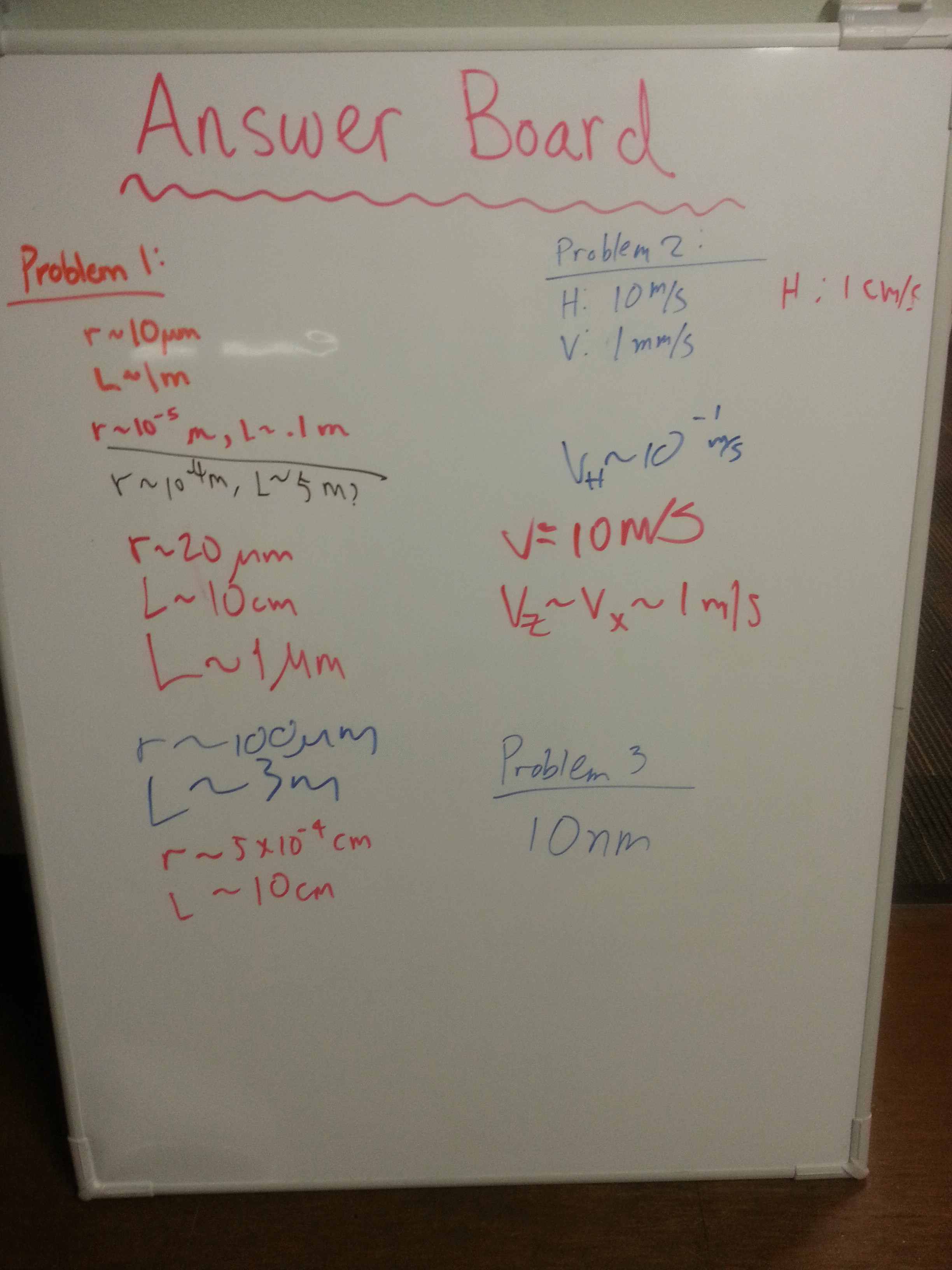
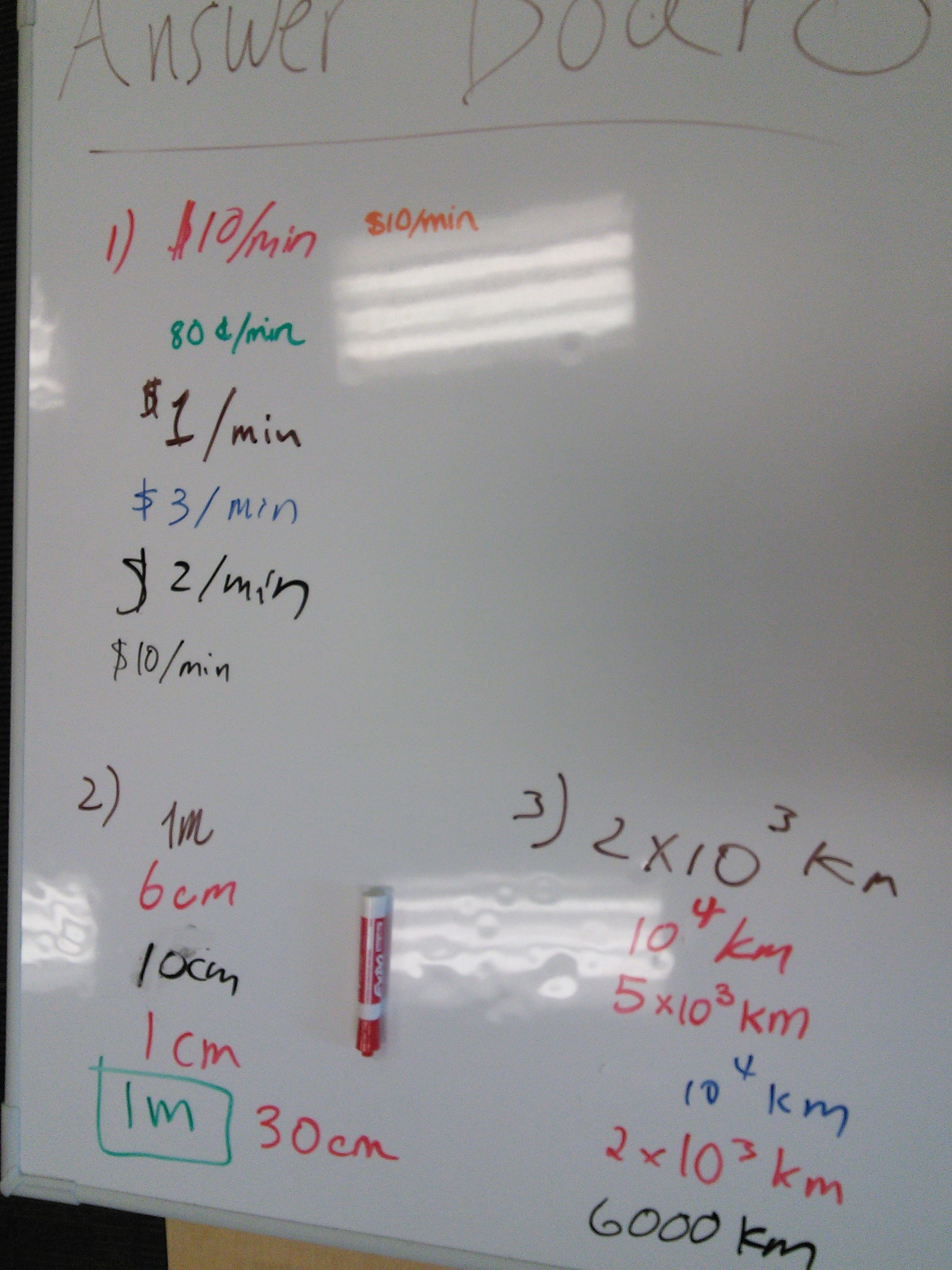
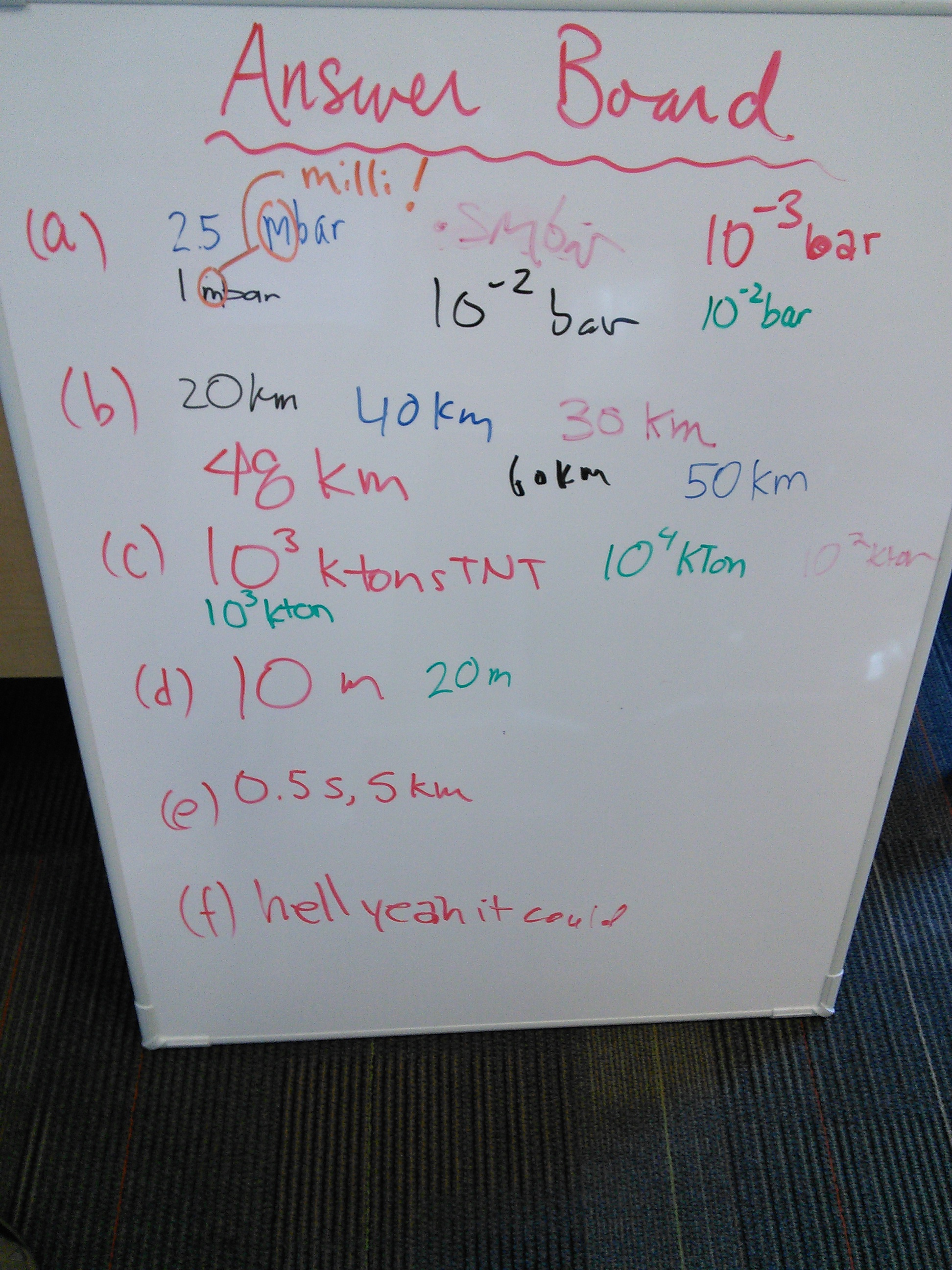
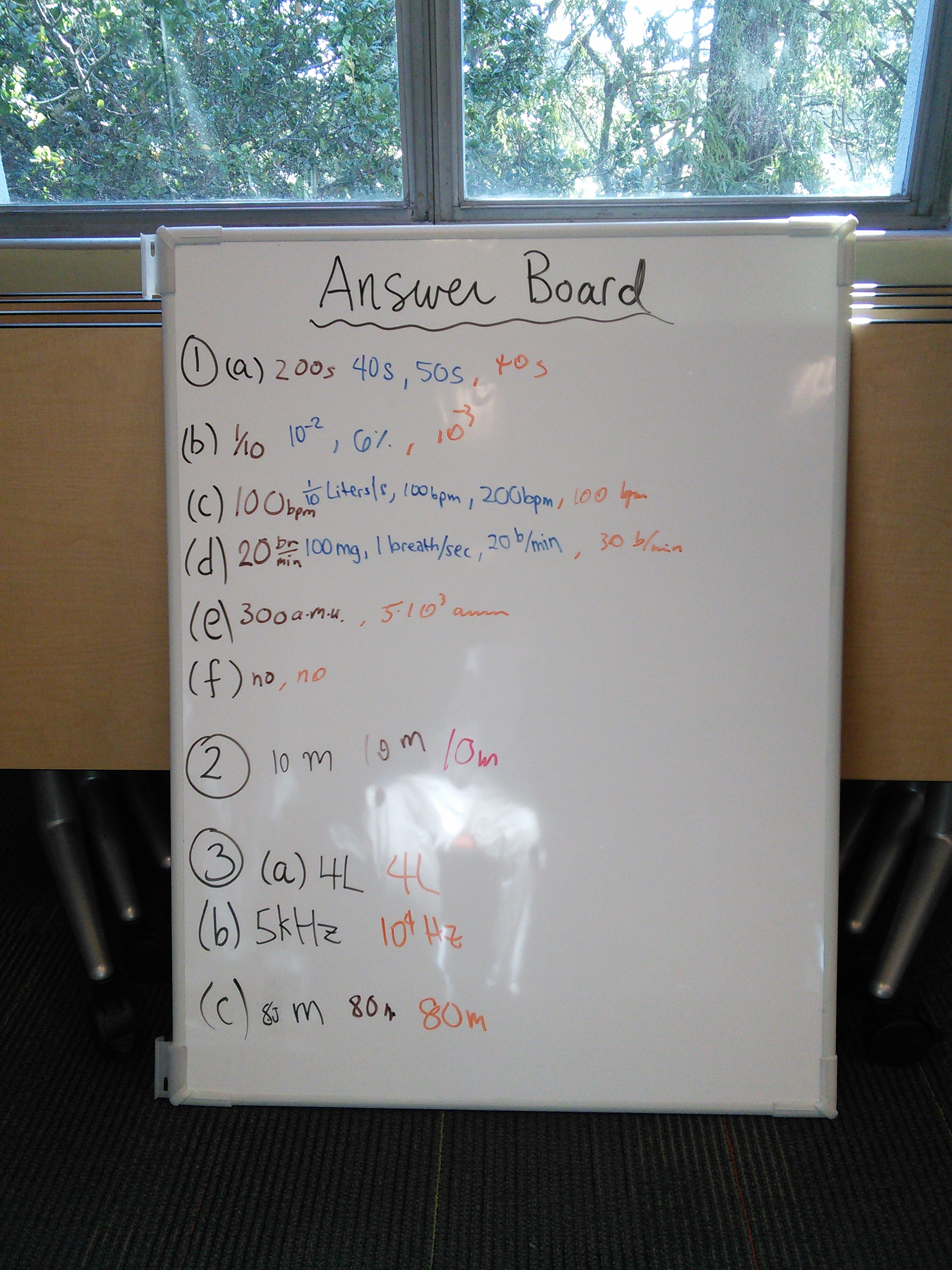
- Bi-weekly Thursday labs (in lieu of lecture) where groups of 1–3 people solve problems in real time.
- Course hand-out from first class (PDF).
Grading
- Problem Sets: 50%
- Thursday Labs: 25% (participation is sufficient for full credit)
- Final Exam (3 hours; take-home): 25%
- Letter grade assignment: A (≥ 90%) / B (75–90%) / C (65–75%) / P/NP or S/F: dividing line is at 65%.
Texts
There is only one required text for this class: the Astro 250 Course Reader, available for purchase at Copy Central on Bancroft. We will refer to the Reader throughout lecture, and its contents may be useful for the problems.
Sanjoy Mahajan is in the process of writing a textbook on order-of-magnitude physics. I cannot recommend this book more: it is lucid, funny, and captures the spirit and practice of this course.
Aside from Sanjoy’s textbook, a few order-of-magnitude textbooks I like include:
- Consider a Spherical Cow: A Course in Environmental Problem Solving by Harte. A physicist by training, John Harte has taught environmental science and OOM estimation at Berkeley to high acclaim for many years.
- Consider a Cylindrical Cow: More Adventures in Environmental Problem Solving by Harte. The exciting sequel.
- Back-of-the-Envelope Physics by Swartz. Concise, readable, quantitative set of questions and answers, written by an Oersted Medalist.
- Physics to a Degree by Raine. A wonderful set of problems and solutions.
- The Flying Circus of Physics by Walker. Fun smorgasbord of questions with answers and pointers to the literature.
Some of the course material is drawn from these excellent texts:
- Gases, Liquids, and Solids by Tabor (the first-year undergraduate text at Cambridge University)
- Introduction to Solid State Physics by Kittel
- Physical Fluid Dynamics by Tritton
- Fundamentals of Fluid Mechanics by Munson, Young, and Okiishi
- Fluid Mechanics by White
- On Size and Life by McMahon and Bonner
- Random Walks in Biology by Berg
- Music, Physics, and Engineering by Olson
- The Science of Musical Sound by Pierce
- Waves and Oscillations by Crawford
- and our trusty rag Physics Today, which occasionally has nice tutorial pieces.
Movies
- In the 1960s, the National Committee for Fluid Mechanics Films, led by Ascher Shapiro of MIT under the auspices of the National Science Foundation, created a set of beautiful and entertaining films on fluid dynamics. These have been uploaded to YouTube courtesy of Barry Belmont. The films come with a nearly complete set of notes.
Berkeley Physics Colloquia
- Click here for webcasts of the Berkeley Physics Colloquia.
Problem Sets
- PS 1 — Due Thursday Sep 4 (PDF)
- PS 2 — Due Thursday Sep 11 (PDF)
-
PS 3 — Due Thursday Sep 18 (PDF)
- PS 4 — Due Thursday Sep 25 (PDF)
- PS 5 — Due Thursday Oct 2 (PDF)
- PS 6 — Due Thursday Oct 9 (PDF)
-
PS 7 — Due Thursday Oct 17 (PDF)

- PS 8 — Due Thursday Oct 24 (PDF)
- PS 9 — Due Thursday Oct 30 (PDF)
- PS 10 — Due Thursday Nov 6 (PDF)
- PS 11 — Due Thursday Nov 13 (PDF)
- PS 12 — Due Tuesday Nov 25 (or before) (PDF)
Tuesday Labs (127 Dwinelle)
- Lab 1 — Tuesday Sep 9 (PDF)
- Lab 2 — Tuesday Sep 23 (PDF)
- Lab 3 — Tuesday Oct 7 (PDF)
- Lab 4 — Thursday Oct 23 (PDF)
- Lab 5 — Tuesday Nov 4 (PDF)
- Lab 6 — Tuesday Nov 25 (PDF)
Topics
The Virtues of Estimation
- It’s fun.
- Develops physical intuition in a way that solving complicated equations might not.
- Enables you to learn different subjects efficiently.
- Enables you to decide whether a research problem is worth attacking.
- Enables a check on numerical solutions.
- Sometimes you actually know the answer, but only fear and self-doubt prevent you from realizing it. If the class trains you to stop and think before reflexively saying “I don’t know,” then we will consider it a success.
- Even if it turns out you were wrong in your initial estimate, you will appreciate precisely why you were wrong (i.e., you can pinpoint exactly which factor you mis-estimated). As a result, you will be less likely to forget the answer, and you will better appreciate the subtlety of nature. “It is better to have estimated and erred than never to have estimated at all.”
Everyday Estimation
Material Properties
- Atomic sizes and binding energies
- Densities
- Latent heats of vaporization and of fusion
- Specific heats
- Coefficient of thermal expansion
- Elastic moduli
- Yield stresses
- Surface tension
- Kinematic viscosities for gases and liquids
- Thermal diffusivities / conductivities of insulators (diffusion equation: solving equations without solving them)
- Electrical conductivities of metals
- Permanent magnets
- Sample questions
Buckingham Pi Theorem
- Buckingham Pi: if there are m physical variables defined in terms of n independent fundamental quantities, then there are m − n independent dimensionless groups.
- Limitations of Buckingham Pi:
- Must pray that dimensionless coefficients are order unity.
- When m − n > 1: what combination?
- When dimensionless quantities are desired: what exponent?
- Sample questions
Fluid Mechanics
- Pressure drag laws:
- Subsonic: free molecular, Stokes, turbulent
- Supersonic
- Skin-friction drag laws:
- Laminar boundary layer
- Turbulent boundary layer
- Flying:
- Parasitic drag (waste power) = pressure + skin-friction
- Induced drag (useful power) = fighting gravity
- Minimum power for flying vs. size, from hummingbirds to 747s
- Wave-making drag and the Froude number
- Ekman boundary layers
- Sample questions
Waves and Sound
- Applying the Buckingham Pi Theorem to derive the dispersion relation for water waves
- Power scalings for monopoles, dipoles, and quadrupoles
- Sample questions
Miscellaneous
Tips when estimating
- The question matters.
- Substitute / work by analogy.
- Think in bulk.
- “Steady-state” is your friend.
- Do it another way to check.
- Apply common sense.
- “Use the Force.”
- Convert money into salaries.
- Numbers are meaningful only when normalized or compared.
- Itemizing is OK, but look for shortcuts.
- Take no prisoners.